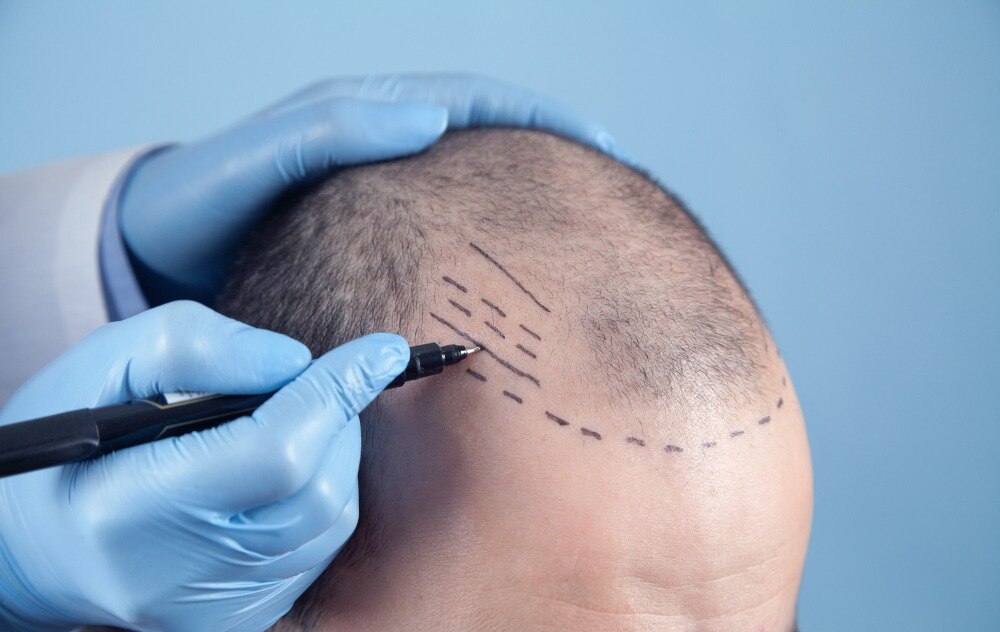
Thinning hair looks different at the hairline, temples, crown, and part line, so the transplant plan must match the pattern and the cause of loss. By the end, you will understand how surgeons select donor follicles, compare FUE, FUT, and DHI, estimate grafts, and judge whether the expected density is realistic.
Key takeaways
- Transplants redistribute existing follicles; they do not create new hair.
- FUE, FUT, and DHI differ in extraction, handling, and implantation.
- Ask how the surgeon calculated your graft count and donor-area limits.
- Treat active hair loss before transplanting when thinning is still progressing.
How transplanted follicles restore a thinning area
A hair transplant for thinning areas improves density by redistributing existing follicles, not by creating new ones. Surgeons move follicular units from the donor area, usually the stronger-growing hair at the back and sides of the scalp, into the recipient area where coverage has weakened.
The visual gain comes from placement. Follicular units are arranged to reduce scalp show-through at the hairline, part line, or most visible gaps. Hair caliber, curl, colour, scalp contrast, and the angle of implantation all affect how full the area appears.
The result can look denser than before without matching the density of an unaffected scalp.
A graft is not the same as one hair. One graft can contain a single follicle or several follicles, so graft numbers alone do not predict coverage. A surgeon also considers the number of hairs within each graft and uses smaller units near the hairline for a natural transition.
The donor area sets the ceiling. It contains a finite supply, and removing too many follicles can make it visibly thin. Diffuse hair loss requires extra caution because thinning may affect both the donor and recipient areas. After placement, transplanted hairs often shed during the first several weeks, while the follicles remain.
New growth commonly begins around three to four months and matures over roughly nine to twelve months.
FUE, FUT, and DHI: what changes between methods
The main difference is where the procedure changes: FUT removes a strip, FUE removes individual follicular units, and DHI changes implantation rather than extraction.
| Option | Extraction | Implantation, scarring, and recovery | Likely density |
|---|---|---|---|
| FUT hair transplant | A strip of donor scalp is removed and divided into grafts. | The donor wound is closed, leaving a linear scar; healing takes longer than with punch extraction. | Can provide many grafts efficiently, but density still depends on donor supply and placement. |
| FUE hair transplant | Follicular units are removed one by one with a punch. | It leaves many small circular FUE scars, not a genuinely scar-free donor area; recovery is usually easier than strip surgery. | It does not automatically produce higher density, and overharvesting can cause patchy donor thinning. |
| DHI hair transplant | Usually uses FUE-like individual extraction. | A hollow implanter pen places grafts directly, reducing the separate recipient-site opening step; recovery and scarring still reflect the extraction method. | No inherent density advantage; graft quality, spacing, hair caliber, and surgeon planning matter more. |
FUE suits people who prefer short hairstyles because its marks are dispersed, while FUT can preserve more donor tissue for a large session but makes a linear scar harder to hide. Be cautious with “scarlessly marketed” FUE scars: every punch creates a small scar, and aggressive extraction can visibly deplete the donor zone.
DHI is not a separate source of follicles. It is an implantation technique, so it cannot overcome limited donor supply or guarantee fuller coverage.
How surgeons plan the hairline, crown, and graft count
A surgeon decides graft placement by matching the thinning pattern with the donor supply, not by filling every visible gap. Examination measures donor density, hair caliber, curl, colour contrast, scalp characteristics, and the likely progression of hair loss.
Hairline design receives particular attention. An excessively low, straight line consumes donor follicles and can look unnatural as age-related recession continues. A conservative, irregularly feathered edge uses frontal hairline grafts efficiently while preserving options for future loss.
A graft is not the same as a hair. One graft may contain one to four follicles, so graft count versus hair count must
Who can benefit, and when transplanting is the wrong first step
Transplantation benefits stable pattern baldness when thinning affects the receding hairline, temples, crown, or other areas while the donor zone remains dense. It redistributes existing follicles, so limited donor supply—not the size of the bald area alone—sets the ceiling for coverage.
| Pattern | Donor and diagnosis | Candidacy |
|---|---|---|
| Pattern baldness | Confirmed androgenetic loss with stable back-and-side donor hair | Often suitable after assessing progression and donor density |
| Diffuse thinning | Diffuse thinning may involve the donor area, especially in women | Selective; extraction can make the donor region visibly thinner |
| Patchy, inflamed, or scarred loss | Check for alopecia areata, scarring alopecia, scalp inflammation, or systemic illness | Treat and stabilise the cause before considering surgery |
A diagnosis must come before graft planning. Sudden shedding, smooth patches, itching, redness, scaling, or scarring calls for medical evaluation; transplanting into active alopecia areata or scarring alopecia can produce poor or temporary growth. The same caution applies when ongoing hair loss has not been stabilised.
The occipital and temporal hairs resist androgenetic miniaturisation, but that resistance is not absolute. Ask how donor density, miniaturisation, hair calibre, and future loss affect crown hair transplant sustainability, especially with advanced or diffuse loss. Medication or observation may be the better first step when the donor zone is weakening.
What recovery and final density look like over 12 months
Expect a staged change, not immediate fullness. The hair transplant recovery timeline runs from post-operative redness and crusting to gradual growth, with final density assessed around 9–12 months rather than during the first few weeks.
1. Days 1–14: Follow washing and activity instructions while crusts loosen. Swelling, tenderness, and temporary redness can occur. Do not pick scabs or judge density from the short, uneven hair.
2. Weeks 2–8: Shock loss often makes the recipient area look thinner. This hair transplant shedding affects the visible hair shaft while the transplanted follicle remains in place, so early shedding does not automatically mean graft failure.
3. Months 3–6: New hairs commonly begin appearing around month 3 or 4. They may grow slowly, look fine, or lack uniform direction at first.
4. Months 7–12: Hairs gain length, caliber, and coverage. The crown can mature later than the hairline, and some patients need longer than 12 months for full maturation.
Evaluate the result with standardised photographs: same camera, lighting, distance, hairstyle, and dry-hair condition at baseline, 6 months, and 12 months. Compare coverage in the planned zone, hairline naturalness, scalp show-through, and whether native hair around the grafts has continued thinning. A successful result improves visual density; it does not recreate unaffected-scalp density.
At Khatri Clinic - Best Clinic in Camp 08048047677, ask for a diagnosis, graft plan, baseline photographs, and a plan to protect non-transplanted hair before judging hair transplant results after 12 months. Ongoing treatment such as topical minoxidil, or finasteride for appropriate men after medical discussion, may help preserve surrounding hair.
Related service
Hair Treatment Struggling with Hair Fall or Bald Patches? Expert Help is Here. View service → |
Frequently asked questions
How does a hair transplant restore a thinning area?
A surgeon moves follicular units from the stronger-growing donor area at the back and sides into thinning recipient areas.
What is the difference between FUE, FUT, and DHI?
FUE removes individual follicular units, FUT removes a strip of scalp, and DHI places grafts with an implanter pen.
How do surgeons plan the hairline, crown, and graft count?
They assess the pattern of hair loss, donor density, hair characteristics, desired coverage, and the number of grafts the donor area can safely provide.
Who should consider a hair transplant, and when is it the wrong first step?
Candidates need sufficient donor hair and a stable treatment plan; active or unexplained hair loss should be evaluated before surgery.
What does hair transplant recovery look like over 12 months?
Scabs and redness settle first, transplanted hairs shed before regrowth, and density develops gradually over the following months.