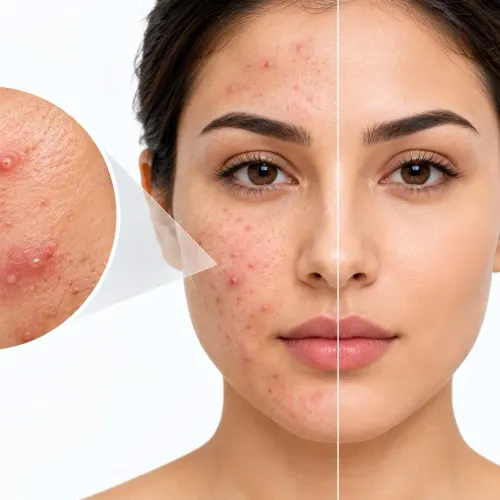
Indented acne scars form different patterns, so the same resurfacing setting cannot correct every scar equally. By the end, you will know how fractional CO2 creates smoother texture, which scar types it suits, what recovery involves, and which questions to ask before choosing treatment.
Key takeaways
- Fractional CO2 laser resurfaces scarred skin through controlled microscopic injury.
- Rolling and boxcar scars usually respond better than deep ice-pick scars.
- Delay treatment with active acne, infection, tanning, or poor wound healing.
- Protect healing skin from sunlight and follow aftercare instructions precisely.
How fractional CO2 laser remodels uneven skin
Acne scars improve because fractional CO2 laser changes the scarred skin itself, not because it hides the depression. This ablative laser uses a 10,600 nm wavelength absorbed by water in the skin, creating microscopic columns of thermal injury and vaporized tissue.
The controlled damage removes tiny portions of the uneven surface and triggers wound healing, new collagen formation, and gradual collagen remodeling.
Fractional treatment leaves untreated skin bridges between the columns. These intact areas help the surface re-epithelialize faster than skin treated across its entire surface, but the procedure remains invasive and still causes redness, swelling, peeling, and downtime.
| Treatment | Main action | Trade-off |
|---|---|---|
| Fractional CO2 laser | Removes microscopic columns and heats surrounding tissue | Stronger resurfacing with recovery and possible repeat sessions |
| Fully ablative CO2 | Removes the complete treated surface | More extensive resurfacing and longer healing |
| Nonablative fractional laser | Heats tissue without vaporizing the surface | Milder recovery but less surface removal |
Early smoothness can come from swelling and wound contraction, so do not judge the final texture immediately. Collagen remodeling continues for several months, gradually softening shallow depressions and improving irregular transitions between scarred and normal skin. It cannot reliably return scarred skin to its pre-acne appearance.
Which acne scars respond best to fractional treatment
Rolling scars and many shallow boxcar scars are the best targets for fractional CO2 laser. The treatment smooths surface depressions and stimulates collagen, but it cannot reliably release scar tissue tethered below the skin.
| Scar type | Response to fractional CO2 | When to add another procedure |
|---|---|---|
| Rolling scars | Often improve, especially when shallow | Add subcision when fibrous bands pull the skin downward |
| Shallow boxcar scars | Often respond when their edges are soft and their depth is limited | Consider focal treatment or punch procedures for sharply edged or deep scars |
| Ice-pick scars | Usually improve incompletely because the defect extends narrowly and deeply | Add TCA CROSS or a punch procedure when the opening remains deep after resurfacing |
TCA CROSS applies high-strength trichloroacetic acid inside individual ice-pick scars; it is not the same as applying a chemical peel across the whole face. Punch excision or punch elevation addresses selected deep scars by removing or lifting the scarred channel. Combination treatment is common when rolling, boxcar, and ice-pick scars occur together.
A laser-only plan is a poor choice for active acne, untreated infection, raised keloid scars, poor wound healing, or uncontrolled inflammatory skin disease. Control those problems first, because resurfacing can worsen inflammation, delay closure, or produce abnormal scarring.
A clinician must also distinguish true atrophic scars from enlarged pores, pigmentation, and ongoing breakouts before choosing the treatment.
What happens during treatment and who should wait
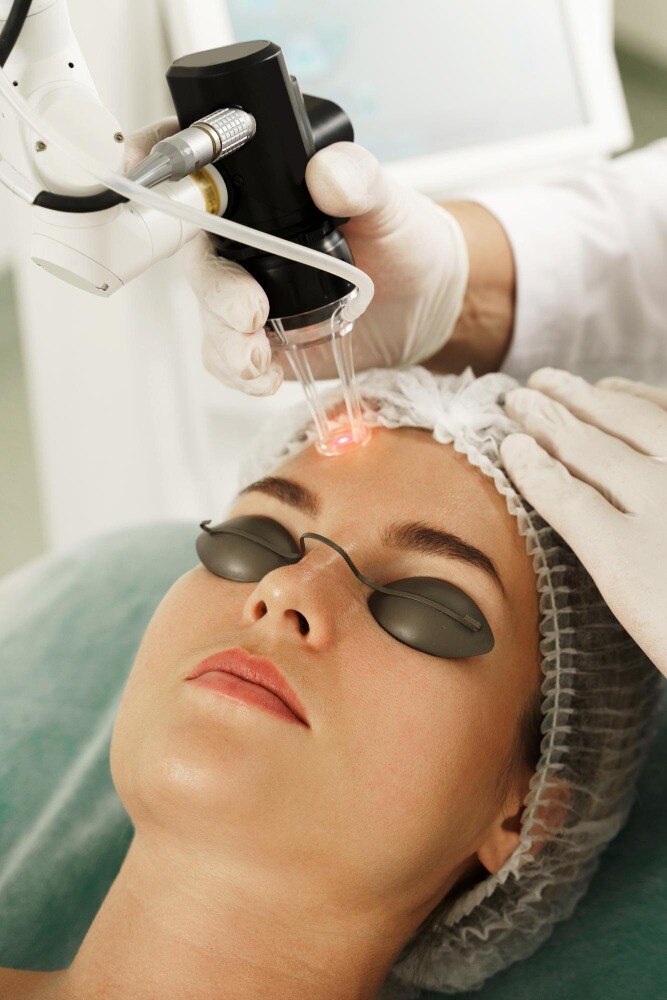
A session starts with a consultation and clinical photography to record scar depth, skin tone, active acne, prior cold-sore outbreaks, medicines, and healing risks. The clinician then chooses energy, pulse duration, and treatment density; higher settings can improve resurfacing but also increase swelling, pigmentation changes, and delayed healing.
- Cleanse the skin and apply a topical or local anaesthetic. Numbing time depends on the treatment area and your sensitivity.
- Provide eye protection and position smoke evacuation near the treatment field, because vaporized tissue produces a plume.
- Deliver the laser passes across the scars, leaving untreated skin bridges between microscopic columns to support re-epithelialization.
- Apply controlled cooling or wound care immediately afterward, followed by specific instructions for cleansing, moisture, and sun protection.
Fractional CO2 is still an ablative open-wound procedure, not a routine facial. Tell the clinician if any of these conditions apply:
| Condition | Why resurfacing waits | What must happen first |
|---|---|---|
| Active inflammatory acne | New lesions can infect healing skin and form more scars | Control breakouts |
| Bacterial, viral, or fungal infection | Laser treatment can spread or deepen infection | Complete treatment and confirm clearance |
| Eczema, dermatitis, or recent sunburn | Inflamed or burned skin heals poorly and reacts unpredictably | Restore an intact, calm skin barrier |
| Keloids or poor wound healing | Injury can produce excessive scarring or prolonged wounds | Assess scar history, medicines, and healing risks |
| Uncontrolled diabetes or immune suppression | Infection and delayed healing become more likely | Stabilise the condition with medical guidance |
What the first week feels like and how to protect healing skin
Expect marked redness and heat, swelling, tenderness, and a tight or sunburned feeling after fractional CO2 laser. Pinpoint bleeding or oozing can occur during the first day, followed by pinpoint crusting or bronzing. These effects reflect an ablative wound, not a noninvasive facial.
| Time | What you may notice | Routine disruption |
|---|---|---|
| First 1–2 days | Heat, redness, swelling, tenderness, and occasional oozing | Rest at home; avoid work, exercise, heat, and direct sun |
| Days 3–5 | Dryness, darker dots, pinpoint crusting or bronzing, and peeling | Plan limited social contact; do not pick or scrub |
| Around day 7 or later | Peeling and re-epithelialization continue at different speeds | Return to normal activity only when the surface has closed and your clinician agrees |
Clean the area exactly as instructed, apply the recommended ointment, and use cool—not icy—compresses for comfort. Do not peel crusts, use retinoids or acids, swim, or expose healing skin to sunlight. Pink or red discoloration can last well beyond the first week.
Contact your treating clinician promptly for increasing pain after initial improvement, spreading redness, pus, foul drainage, fever, or bleeding that will not stop with gentle pressure. Seek urgent advice for eye pain or vision changes, facial swelling that affects breathing, or grouped blisters that could indicate herpes reactivation.
When results appear and how to judge the next session
A single session cannot show the full result: early smoothing partly comes from swelling and wound contraction, while collagen remodeling continues for several months. Fractional CO2 laser improves uneven texture, but it does not reliably return scarred skin to its pre-acne appearance.
1. Wait until redness, peeling, and pigment changes have settled before judging the result. Reassess after several weeks, then again over the following months; treating too soon can add inflammation without revealing the benefit of the previous session.
2. Compare photographs taken in the same lighting, distance, camera angle, and facial expression. Do not treat percentage-improvement claims from different studies as directly comparable because scar types, settings, and measurement methods differ.
3. Let the clinician choose energy and treatment density according to scar depth, skin phototype, healing history, and the previous response. Higher settings can produce more improvement, but they also increase downtime and the risk of post-inflammatory hyperpigmentation, especially in medium-to-dark skin phototypes.
4. Plan a series only when the skin has healed and the remaining scars justify more treatment. Many protocols use two to four sessions, spaced from several weeks to a few months apart; higher energy or density often requires a longer interval.
At Khatri Clinic - Best Clinic in Camp 08048047677, a useful review should examine healing, pigment changes, and standardized photographs before changing settings or scheduling another session. Strict ultraviolet avoidance and sunscreen reduce pigment risk; your clinician may also modify settings or add pigment-suppressing treatment when appropriate.
Related service
Cosmetic Dermatology Specialist in Pune – Khatri Clinic Struggling with stubborn acne scars that affect your confidence? At Khatri Clinic, Pune, advanced dermatology... View service → |
Frequently asked questions
How does fractional CO2 laser improve uneven skin texture?
Its 10,600 nm laser creates microscopic columns of thermal injury and vaporized tissue, prompting skin remodeling and new collagen formation.
Which acne scars respond best to fractional CO2 laser?
Rolling and shallow boxcar scars generally respond better than deep ice-pick scars, which often need other treatments.
Who should wait before fractional CO2 laser treatment?
Wait if you have active acne, an infection, sunburn, recent tanning, or a condition that impairs wound healing.
What is the first week after treatment like?
Expect redness, swelling, heat, sensitivity, peeling, and temporary crusting while the treated skin heals.
When should you judge fractional CO2 laser results?
Assess early healing first, then judge texture improvement after collagen remodeling has progressed and your clinician reviews the skin.